The Forgetting Curve: Why You Forget 70% of What You Learn in 24 Hours

You finish an online course, close the tab, and feel like you learned something. A week later someone asks you about it and you can barely piece together the main points. Nothing is wrong with your memory. This is the forgetting curve, one of the oldest and most reliable findings in memory research: in Ebbinghaus's classic self-experiment, roughly two-thirds of the learning effort had evaporated within a day. Meaningful material fades more slowly, but the shape holds unless you do something about it.
The curve is also very beatable. This guide covers what it is, why your brain works this way, and the review techniques with real evidence behind them, so the hours you put into learning compound instead of leaking away.
What is the forgetting curve?
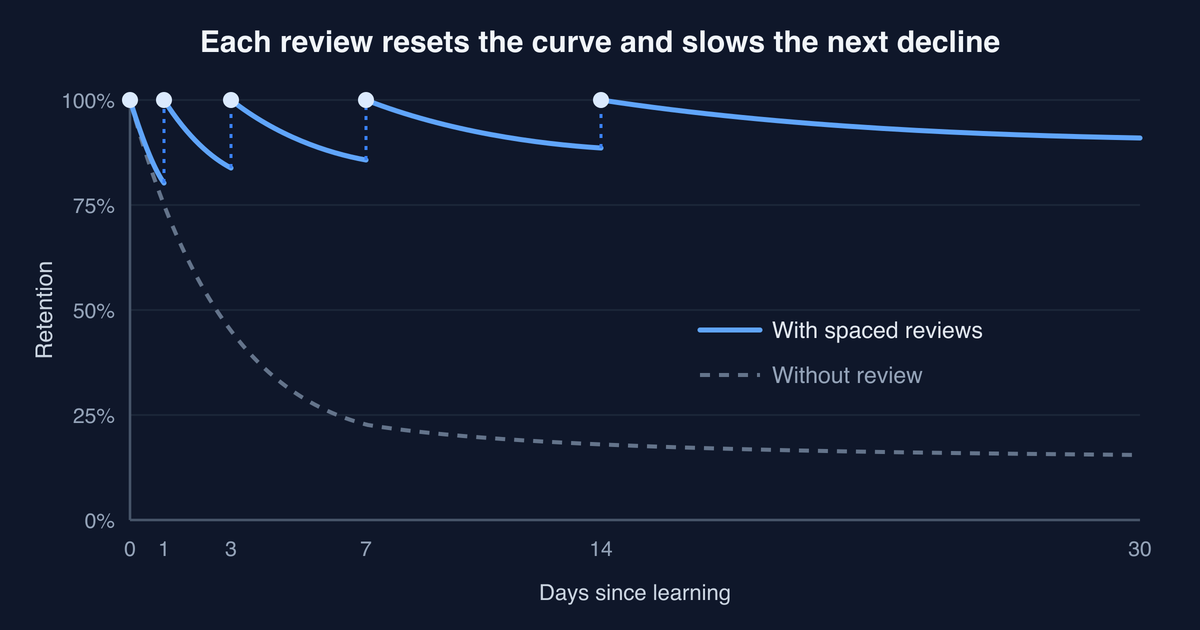
The forgetting curve describes how memory fades when you don't reinforce it. Forgetting is steepest right after learning: you lose the most in the first hours and days, then the decline levels off. Every successful review interrupts the slide and slows the next one, which is the whole basis of spaced repetition.
The curve was first measured in 1885 by German psychologist Hermann Ebbinghaus, who spent years memorizing lists of nonsense syllables and testing how much he could relearn after various delays. His results have held up remarkably well. In 2015, researchers replicated his original experiment with modern methods and got the same shape.
How fast do you actually forget?
Exact numbers vary by person and by material. Ideas that connect to things you already know fade slower than isolated facts. Still, Ebbinghaus's data gives a rough baseline for learning that never gets reviewed:
| Time after learning | Approximate retention |
|---|---|
| 20 minutes | ~60% |
| 1 hour | ~45-50% |
| 24 hours | ~30-35% |
| 1 week | ~25% |
| 1 month | ~20% |
Apply that to a real course. If course material behaved like Ebbinghaus's syllables, ten hours of unreviewed study would leave you with a fraction of it. Real material does better, but not by enough to skip reviewing. The rest turns into rework, or into things you simply never get to use.
Why does your brain forget so aggressively?
Forgetting looks like a design flaw, but it's mostly triage. Your brain is constantly deciding what deserves long-term storage, and it uses a blunt rule: information you retrieve and use gets kept, information you never touch again gets pruned. Three forces pull the curve down:
- Storage decay. Memory traces weaken physically over time unless they get reactivated. One exposure rarely builds a durable trace.
- Interference. New learning competes with old learning, especially when the material is similar. The more you learn, the more your memories jostle for space.
- Retrieval failure. Often the memory still exists but the path to it has gone cold. That's why a small hint can bring the whole thing back.
The fix follows directly from the mechanism. If the brain keeps what gets retrieved, then scheduling retrieval is how you vote for a memory to survive.
How to beat the forgetting curve: 4 techniques with real evidence
1. Spaced repetition: review right before you forget
Instead of cramming, spaced repetition schedules reviews at expanding intervals, commonly around 1 day, 3 days, 7 days, 14 days, and 30 days after first learning. Each review catches the memory just as it starts to slip. Each successful recall flattens the curve further, so the next review can wait longer. A major research review by Dunlosky and colleagues rated distributed practice one of only two techniques, out of ten reviewed, with high utility (2013). The other is retrieval practice, covered next.
2. Active recall: test yourself instead of rereading
Rereading notes feels productive because the material looks familiar. Familiarity is not memory. In a well-known 2006 study, Roediger and Karpicke found that students who tested themselves remembered far more a week later than students who spent the same time re-studying. Researchers call this the testing effect, and it is the engine inside every effective review: close the notes and make your brain produce the answer. The effort of retrieval is what strengthens the trace.
3. Mixed practice: interleave related topics
Reviewing one topic in a single block feels smooth. Mixing several related topics feels harder, and that difficulty is useful. Interleaving forces your brain to repeatedly tell concepts apart and pick the right approach, which builds knowledge that transfers better than blocked repetition does.
4. Sleep: the consolidation step you can't skip
Memory consolidation, the process that stabilizes new memories, happens largely during sleep. Sleep is when new memories consolidate, so a review followed by a full night's sleep tends to do more for retention than the same hour spent studying late. If you're serious about remembering, protect the night after you learn.
The catch: nobody sticks to the schedule by hand
The evidence is strong and the schedule is simple. Almost nobody follows it manually, though. Tracking dozens of topics, each on its own expanding timetable, is bookkeeping, and bookkeeping is where study habits go to die. The learners who beat the forgetting curve are usually the ones who automate the scheduling and just show up for the reviews.
This is the problem Mind Tiles was built around. It breaks whatever you want to learn into small tiles, generates the lessons and quiz questions with AI, and runs the review schedule for you on a spaced repetition engine based on the SM-2 algorithm: recall something easily and the gap until its next review grows, miss it and it comes back the next day. Each review is a short quiz written fresh from the module you are revisiting, mixing multiple choice with questions you answer in your own words, so retrieval practice doesn't turn into flashcard grinding. You can read more about how the paths are built in Make Knowledge Last.
Frequently asked questions
What is the forgetting curve in simple terms?
The forgetting curve shows how quickly memory fades without review: steeply in the first hours and days after learning, then more gradually. Hermann Ebbinghaus first measured it in 1885. Each review of the material makes the curve flatter, so you forget more slowly.
How much do you forget in 24 hours?
Without any review, most people retain only around 30 to 35 percent of newly learned information after 24 hours, based on Ebbinghaus's data. Material that connects to what you already know fades more slowly than isolated facts, but the steep early drop applies to almost everything.
Can the forgetting curve be reversed?
You can't stop forgetting entirely, but you can flatten the curve a great deal. Each well-timed review resets the curve and slows the next decline, especially if the review is an active self-test rather than rereading. A handful of well-spaced, successful recalls typically extends retention from days to months; the exact number depends on the material.
What is the best schedule to beat the forgetting curve?
A common starting point is to review after 1 day, 3 days, 7 days, 14 days, and 30 days. Adaptive systems improve on fixed schedules by adjusting each interval to your actual performance: they bring back sooner what you miss and delay what you know well.
Does the forgetting curve apply to skills as well as facts?
Yes, though procedural skills like typing or riding a bike decay far more slowly than factual knowledge. Skills with a large knowledge component, such as programming syntax, vocabulary, or medical protocols, behave much more like facts and benefit strongly from spaced review.
Make the curve work for you
The forgetting curve isn't a reason to feel discouraged. It's a map. It tells you exactly when your memories are at risk and when a five-minute review buys you weeks of retention. Spaced review reliably beats cramming for retention at the same total study time (Cepeda et al., 2006).
If you'd rather not manage the schedule yourself, start a free 7-day trial of Mind Tiles. Tell it what you want to learn, and it will build the path, schedule the reviews, and schedule reviews before memories are likely to slip.