Spaced Repetition Schedule: The Exact Intervals That Make Learning Stick
Spaced repetition is the rare study technique that is both backed by a century of research and genuinely simple: review material at expanding intervals, right before you would otherwise forget it. The part people get stuck on is the schedule itself. When exactly should the reviews happen? One day later? A week? Does it even matter?
It matters a lot, and the research gives clearer guidance here than study advice usually gets. This guide lays out the classic schedule, the reason expanding intervals beat fixed ones, how to adjust when you have a deadline, and the point where scheduling by hand stops being worth it.
What is a spaced repetition schedule?
A spaced repetition schedule is a plan for reviewing material at increasing intervals, for example 1 day, 3 days, 7 days, 14 days, and 30 days after first learning it. Each review is timed to land just before the memory would fade, which strengthens it and earns a longer gap until the next review. A handful of well-timed reviews can extend retention from days to months.
The schedule exists because of the forgetting curve: memory drops steeply right after learning, then more slowly after each successful recall. Expanding intervals simply track that flattening curve.
The classic schedule: 1-3-7-14-30
If you're scheduling reviews yourself, this is the standard starting point:
| Review | When | What to do |
|---|---|---|
| Learn | Day 0 | Study the material actively. Summarize it in your own words instead of just reading. |
| Review 1 | Day 1 | Self-test from memory. Only check your notes after attempting recall. |
| Review 2 | Day 3 | Self-test again. Flag anything you missed for an extra pass tomorrow. |
| Review 3 | Day 7 | Mix this topic with related ones. Interleaving sharpens the distinctions between concepts. |
| Review 4 | Day 14 | Quick recall check. Most items should feel easy now, so spend your time on the stragglers. |
| Review 5 | Day 30 | Final consolidation pass. Material recalled here tends to hold for months. |
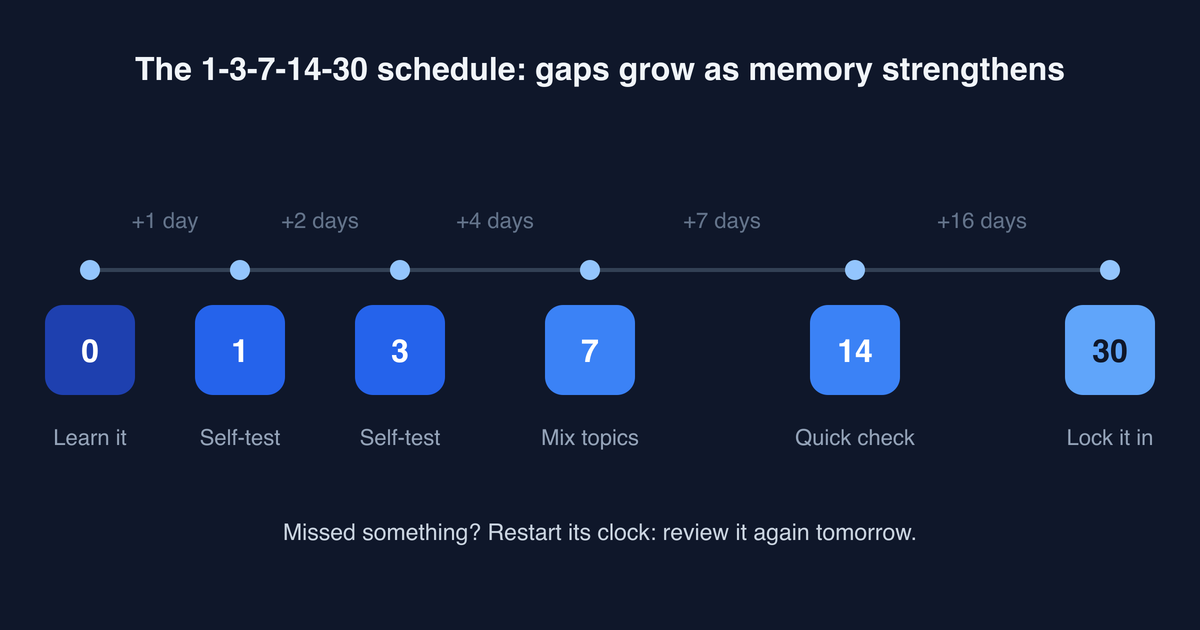
Two rules make or break this table. First, every review must be active recall, meaning you retrieve from memory rather than reread. The testing effect shows that retrieval is what actually strengthens memory, while rereading mostly builds false confidence. Second, missed items restart their clock. If you fail to recall something on day 7, treat it as freshly learned and review it again the next day rather than waiting until day 14.
Why expanding intervals beat fixed ones
Reviewing every single day would work, but it wastes enormous amounts of time, and it turns out to be less effective per hour than spacing. Memory strengthens most when retrieval is effortful but successful, a principle researchers call desirable difficulty. An expanding schedule keeps every review in that zone: hard enough to strengthen the trace, early enough to usually succeed.
There is even research on the right gap size. A large study by Cepeda and colleagues found (2008) that the best single gap between two study sessions was roughly 10 to 20 percent of how long you want to remember the material, for horizons of weeks to months, and proportionally smaller for a year. Want it solid for a month? Space reviews about 3 to 6 days apart. Want it for a year? Push the later gaps toward several weeks. Expanding ladders like 1-3-7-14-30 are a practical way to approximate that.
Adapting the schedule to your situation
- Exam in two weeks: compress to roughly days 1, 2, 4, 7, and 11, and schedule the last full review one or two days before the exam rather than the night before, so sleep can consolidate it.
- Learning for the long haul (a language, professional skills): keep extending past day 30, to day 60, day 120, and beyond. Mature memories only need occasional touches to stay alive.
- Dense or slippery material (formulas, vocabulary, drug names): start tighter, with reviews on days 1, 2, and 4, before expanding. Isolated facts fade faster than connected ideas.
- Material you keep getting right: let it graduate faster. Re-reviewing what you already know is the biggest hidden cost in most study routines.
Manual schedules vs. algorithms: when to stop doing this by hand
The fixed schedule above treats every fact the same. In reality you learn some things in one pass and struggle with others for weeks, which is why most widely used spaced repetition systems moved to adaptive algorithms:
| Approach | How it schedules | Best for |
|---|---|---|
| Fixed schedule (1-3-7-14-30) | Same intervals for everything | Getting started; small amounts of material |
| Classic algorithms (SM-2) | Adjusts each item's interval from your recall quality | Flashcard users willing to rate every card |
| Modern schedulers (FSRS) | Models your memory statistically to predict forgetting | Large collections; efficiency-focused learners |
| AI learning systems | Generates the material and the quizzes, then schedules from your recall | Learners who want the content and the timing handled |
The pattern across all of them: the more the system knows about your actual recall, the less time you spend reviewing things you know and the fewer things slip through. Mind Tiles sits in the last row. Under the hood it runs an SM-2 based engine, so every tile carries its own ease rating that rises and falls with your answers: material you find hard resurfaces sooner, material you breeze through waits longer, and anything you miss comes back the next day. The difference from flashcard apps is that you never write the cards. Mind Tiles generates the lessons and review quizzes itself and mixes the formats, closer to what we describe in our comparison of personalized learning apps.
Common spaced repetition mistakes
- Rereading instead of recalling. If a review doesn't involve producing answers from memory, it isn't really a review.
- Skipping the day 1 review. The steepest forgetting happens in the first 24 hours, which makes this the highest-leverage five minutes in the whole schedule.
- Letting a backlog guilt you into quitting. Missed a few days? Resume with today's most overdue items and move on. An imperfect schedule kept for months beats a perfect one abandoned in week two.
- Batching everything into one weekly session. That recreates cramming. Seventy minutes spread across a week beats the same seventy minutes on Sunday.
Frequently asked questions
What is the best spaced repetition schedule?
A common starting schedule is reviewing 1 day, 3 days, 7 days, 14 days, and 30 days after first learning. Research suggests spacing gaps at roughly 10 to 20 percent of how long you want to retain the material, so extend the later intervals if you're learning for the long term.
How many reviews does it take to remember something permanently?
Nothing is truly permanent without occasional use, but a handful of well-spaced active-recall reviews typically extends retention to months; the exact number depends on the material. After that, an occasional review every few months keeps it accessible.
Should I review before I forget or after?
Just before. The ideal review happens when recall is effortful but still possible, because that difficulty is what strengthens the memory. Once you've forgotten completely you have to relearn, which is slower. Review too early and the easy recall adds little strength.
Is spaced repetition better than cramming?
For anything beyond tomorrow morning, yes, by a wide margin. Cramming can match spaced practice on an immediate test, but retention collapses within days. Spaced repetition trades slightly slower initial learning for far better retention weeks and months later at the same total study time.
Do I need an app for spaced repetition?
No. A calendar and the 1-3-7-14-30 schedule work fine. Manual tracking across many topics is where most people quit, though. Apps automate the timing, and AI systems like Mind Tiles also generate the review questions, which removes the two most common reasons schedules get abandoned.
Start the schedule today
Whatever you learned today is already sliding down the forgetting curve, which means the best time for your first spaced review is tomorrow. Put day 1, day 3, and day 7 in your calendar right now, or let Mind Tiles build and run the schedule for you with a free 7-day trial. You choose what to learn. It schedules the reviews that give you the best shot at still knowing it a month from now.