Active Recall vs Spaced Repetition: Which Should You Use?
Study advice online treats active recall and spaced repetition like rival football teams. Pick a side, defend it in the comments, and dismiss the other as overrated. It makes for lively threads and terrible study plans, because the two techniques don't even compete. They answer different questions.
Active recall is how you review: you close the notes and force your brain to produce the answer. Spaced repetition is when you review: you time each session for the moment a memory is about to slip. One without the other leaves most of the benefit on the table. This guide covers what each technique actually does, the research behind both, the mistakes that quietly cancel them out, and how to run them together without managing a spreadsheet.
What is active recall?
Active recall means retrieving information from memory instead of re-exposing yourself to it. Answering a question from a blank page, explaining a concept out loud, taking a practice quiz: all of these count. Rereading, highlighting, and rewatching lectures do not, because the material is in front of you and your brain never has to reach for it.
The reaching is the point. Memory researchers call this the testing effect: the act of retrieval strengthens the memory far more than another exposure does. In the classic 2006 experiment, Roediger and Karpicke had students either re-study a passage or take practice tests on it. On a quiz one week later, the self-testing group remembered up to about 50% more than the re-readers (61% versus 40% in the most-tested condition), despite equal total time and lower confidence going in.
That confidence gap matters. Rereading creates fluency, the smooth feeling of "I know this," which is precisely what makes it dangerous. Familiarity is not memory. Active recall feels harder because it is doing something rereading never does: proving the memory exists and reinforcing the path to it.
What is spaced repetition?
Spaced repetition means spreading reviews over expanding intervals, commonly around 1, 3, 7, 14, and 30 days, instead of massing them into one long session. Each review lands just as the memory starts to fade, resets it to full strength, and slows the next decline. The technique exists because forgetting follows a predictable pattern, which we covered in detail in our guide to the forgetting curve: without reinforcement, most new knowledge is gone within days.
The evidence base here is about as settled as learning science gets. A landmark review by Dunlosky and colleagues evaluated ten popular study techniques against decades of research and rated exactly two of them as having high utility: distributed practice, which is spaced repetition, and practice testing, which is active recall. Highlighting and rereading, the two most popular techniques among students, landed at the bottom.
If you want the exact timing, our spaced repetition schedule guide breaks down the intervals and why they expand.
Active recall vs spaced repetition: the real difference
Put side by side, the two techniques solve different failure modes:
| Active recall | Spaced repetition | |
|---|---|---|
| What it controls | How you review | When you review |
| Mechanism | Retrieval strengthens the memory trace (testing effect) | Well-timed reviews interrupt forgetting at its steepest point |
| The failure it fixes | Passive review that builds familiarity instead of memory | Cramming that decays within days |
| Typical mistake | Peeking at the answer before genuinely trying to retrieve it | Reviewing on a fixed daily schedule that ignores what you already know well |
| Feels like | Effortful, slightly uncomfortable | Suspiciously little total study time |
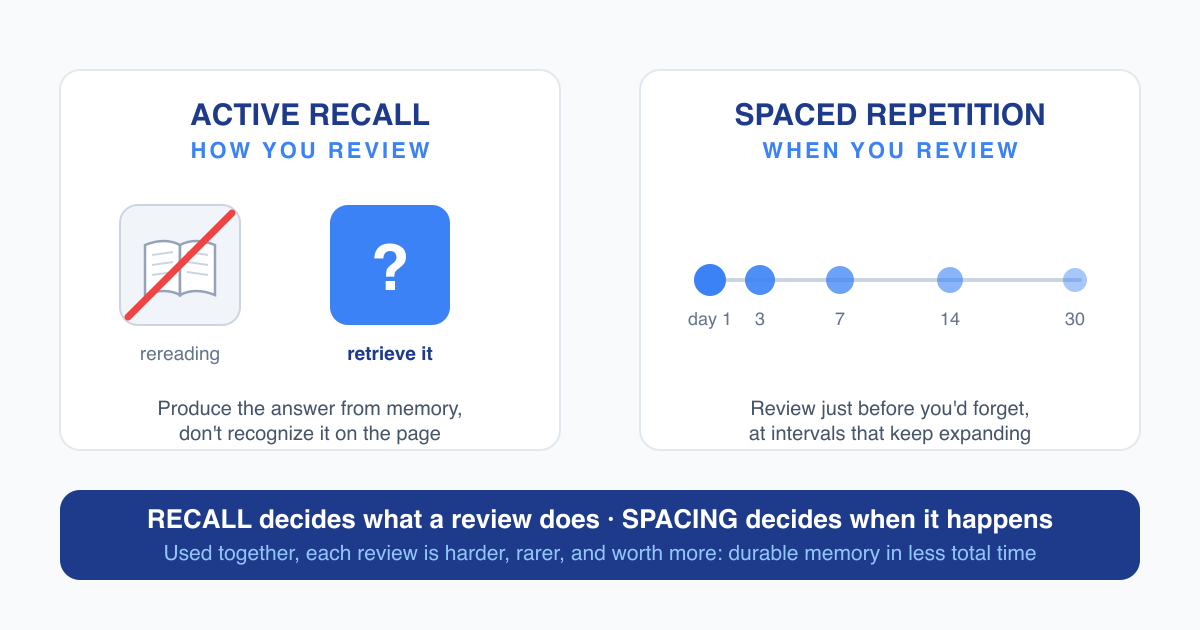
Notice that you can fail at one while doing the other perfectly. Reread your notes on a beautiful expanding schedule and you get well-timed sessions that build very little. Quiz yourself brutally every single day and you get strong retrieval practice at terrible economics, wasting time on cards you already know while the ones you're about to forget wait their turn.
Why you need both
Here's the part the "versus" framing hides: the strongest version of each technique already contains the other.
Spacing works best when each review is a retrieval attempt, because retrieval is what resets the forgetting curve hardest. And retrieval works best when it's spaced, because a slightly faded memory takes more effort to retrieve, and that extra effort produces extra strengthening. Researchers call this desirable difficulty: the review that feels a little too hard is the one doing the most work.
In practice, combining them looks like this:
- Turn material into questions, not summaries. Every concept becomes something you can be asked.
- Answer before you check. Commit to a full answer, out loud or on paper, before revealing anything.
- Let performance set the schedule. Easy recalls push the next review further out. Misses bring it back tomorrow.
- Stop reviewing what the schedule says can wait. This is the step humans skip. Reviewing everything daily feels virtuous and wastes most of the time you spend.
The catch is bookkeeping. Dozens of topics, each on its own expanding timetable that shifts every time you get something right or wrong, is a scheduling job, and scheduling jobs are where study habits go to die.
How Mind Tiles runs both for you
This combination is the core of how Mind Tiles works. It breaks whatever you're learning into small tiles and generates the questions with AI, so every review is a retrieval attempt rather than a rereading session. Quizzes arrive in mixed formats, from multiple choice and matching to fill-in-the-blank and word games, which keeps retrieval practice from turning into flashcard grinding.
The timing side runs on a spaced repetition engine built on the SM-2 algorithm. Recall something easily and the gap until its next review grows. Miss it and it comes back the next day. You never decide what to review; you open the app and the queue is already the set of memories closest to slipping, synced across your phone, tablet, and the web.
Frequently asked questions
Is active recall better than spaced repetition?
Neither is better, because they control different things: active recall determines how you review and spaced repetition determines when. A major 2013 review (Dunlosky and colleagues) rated both as the only two high-utility techniques among ten examined, and each works substantially better in combination with the other than alone.
Can you do active recall without spaced repetition?
Yes, and it still beats rereading by a wide margin. But unspaced recall means you either review everything constantly, which wastes time on material you already know, or review at random, which lets some memories decay past the point of easy recovery. Adding spacing fixes the economics.
Can you do spaced repetition without active recall?
You can space out rereading sessions, and the spacing alone provides some benefit. You lose most of the effect, though, because passive review barely strengthens the memory each session resets. Spacing decides when the review happens; retrieval is what makes the review count.
Is rereading ever useful?
Rereading works for first contact with material you genuinely haven't understood yet. Once you understand something, further rereads mostly build familiarity, which feels like knowledge but doesn't survive a test. The moment you can attempt a question, switch to retrieval.
How many reviews does it take before something sticks long-term?
For most material, a handful of successful spaced retrievals over about a month puts a memory into durable storage, after which occasional maintenance reviews keep it there. Difficult or highly similar material may need a few more cycles.
Stop picking a side
The versus debate has a boring answer and a useful one. The boring answer is "use both." The useful answer is that they're not two techniques at all, but two halves of one system: retrieval makes each review count, spacing makes each review arrive at the right time.
If you'd rather not run that system by hand, start a free 7-day trial of Mind Tiles. Tell it what you want to learn, and it will write the questions, watch what you miss, and schedule every review for the moment it matters most.