How to Study From Lecture Slides for an Exam (When the Slides Aren't the Lecture)
To study from lecture slides for an exam, treat the slides as the outline of the lecture rather than the lecture itself. Find out what the exam is actually written from, rebuild what your lecturer said that never made it onto the slides, turn each slide into questions you answer with the deck closed, space those sessions out toward the exam date, and mix lectures together in the final stretch. Rereading the deck feels like studying, and it is one of the weakest ways to do it.
This guide walks through each step, with the research behind it and the places where that research is thinner than study blogs admit.
Why Slides Alone Let You Down
A slide deck is written to be spoken over. The bullet says "negative feedback loop"; the lecturer spent four minutes on a thermostat example, why it matters, and the one case where it doesn't apply. The exam is usually written by the person who said all of that.
You might expect your own notes to fill the gap. Usually they don't, at least not completely. In a 2018 research summary, Kiewra, Colliot and Lu report that students "routinely record just one third of a lesson's important information in their notes," and that in one study students noted only 13% of the examples a lesson used. The main ideas mostly make it into notes; the finer details and the examples mostly don't.
That doesn't mean slides are bad study material. The research on slide handouts is genuinely mixed. In two experiments, Marsh and Sink (2010) found that students given handouts of the slides took fewer notes; in one experiment they needed less time to prepare for the final test, and in the other they scored better on it. A smaller single-cohort study of physical therapy students (Nelson-Wong and colleagues, 2013) found that complete handouts helped in some courses and less complete ones helped in another, and concluded that the best approach may depend on the course. The honest summary: slides are a fine starting point, and an incomplete one.
Step 1: Find Out What the Exam Is Written From
Before you plan anything, find out where the questions come from. Instructors differ a lot here. One University of Colorado Boulder instructor tells students plainly on a course page that "the exam questions are written from the slides" and not from the readings. In another course, the slides might be a thin summary of a textbook the exam leans on heavily.
Three ways to find out, fastest first:
- Read the syllabus and any exam guidance. Learning objectives are often the closest thing you'll get to a list of exam questions.
- Look at past papers or practice exams, if your course releases them. Check which questions you could answer from the slides alone.
- Ask. "Are exam questions drawn mainly from the slides, the readings, or both?" is a normal question for office hours or a course forum.
The answer decides how much of your time goes into the slides and how much into rebuilding what's around them.
Step 2: Rebuild the Talk-Track
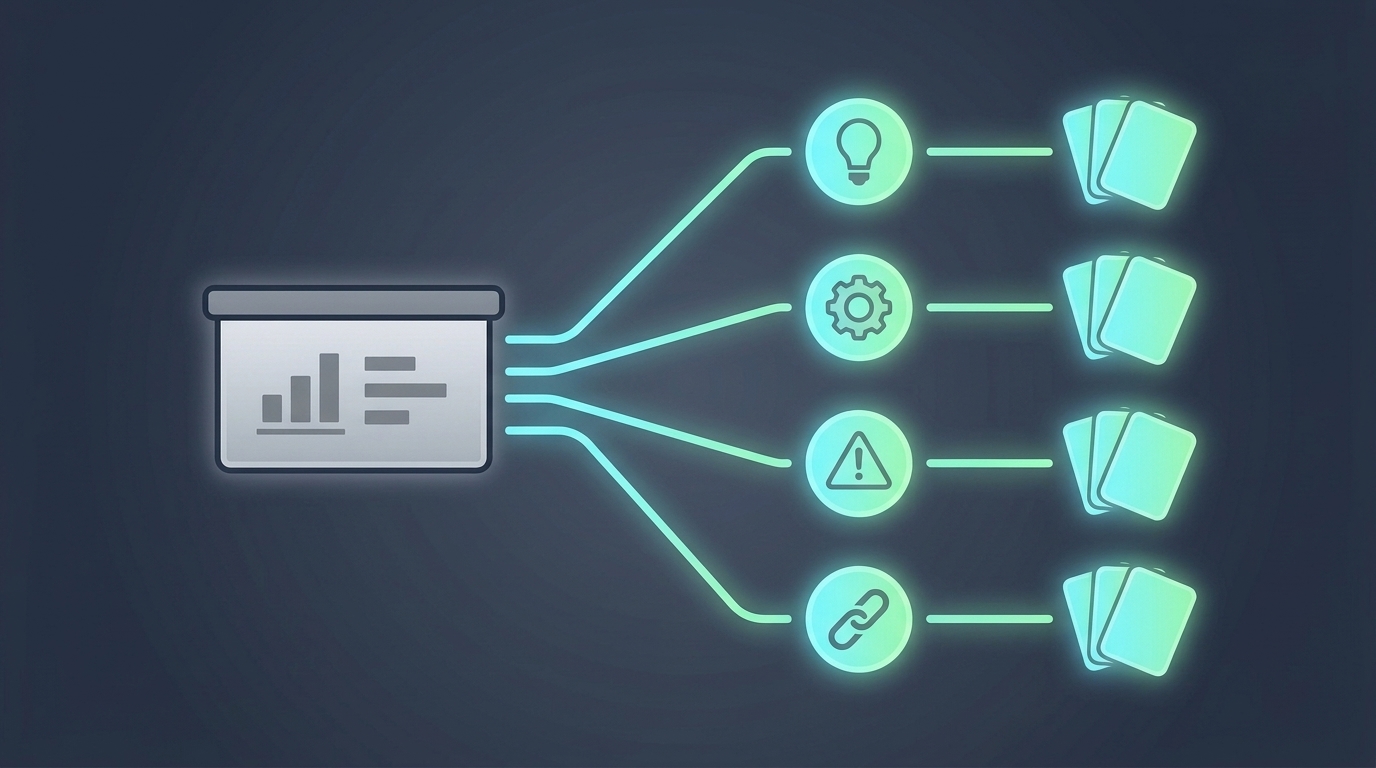
This is the step most guides mention in one line and skip. For each slide, write down what the lecturer said that isn't on it. Four prompts cover most of it:
- The example. What case, story, or worked problem illustrated this slide?
- The why. Why is this true, or why does it matter?
- The exception. Where doesn't it apply, and what's the common mistake?
- The link. How does this slide connect to the one before and the one after?
Fill those in from whatever you have: the lecture recording, your own notes, the assigned reading, or a classmate's notes. When re-watching a recording, listen for the cues that signal something matters. The UNC Learning Center's list includes definitions, examples, lists, superlatives, repetition, and changes in voice or volume.
Any slide where you can't answer the four prompts is a flag, not a failure. It's the slide to bring to office hours, because it's the part of the lecture you currently can't reconstruct at all.
Step 3: Turn Every Slide Into Questions and Answer Them Closed
Rereading slides builds familiarity: you recognize the material when you see it, which is not the same as being able to produce it in an exam hall. In their widely cited 2013 review of ten learning techniques, Dunlosky and colleagues rated rereading and highlighting as low utility. Only two techniques rated high: practice testing and spacing your study out (Step 4), because both "have been shown to boost students' performance across many criterion tasks and even in educational contexts." A 2017 meta-analysis by Adesope, Trevisan and Sundararajan reached the same conclusion: practice tests were "more beneficial for learning than restudying and all other comparison conditions."
So convert the deck into questions, close it, and answer from memory:
- Slide title to question. "Stages of mitosis" becomes "What are the stages of mitosis, in order, and what happens in each?"
- Talk-track to question. Your four prompts from Step 2 become the harder questions: "Why does a thermostat count as negative feedback?" or "When does this rule fail?"
- Diagram to blank page. Redraw the diagram from memory, then compare it with the slide and note what you left out.
Don't make a flashcard for every bullet. A deck of three hundred trivial cards can take longer to review than the slides take to read, and it mostly tests the easy parts. Aim your questions at what an examiner would ask. Check each answer against your sources, and mark the ones you got wrong: those are your study list.
If you'd rather not write the questions by hand, AI tools can draft them from a PDF of the slides; we compared eight of them in our guide to AI flashcard generators. Whatever drafts the questions, the answering still has to be done by you, from memory.
Step 4: Space Your Sessions Toward the Exam Date
Spreading the same study time across several sessions beats cramming it into one, and the gap that works best depends on how far away the test is. In a large study, Cepeda and colleagues (2008) taught more than 1,350 adults a set of facts, reviewed them after a gap of up to three and a half months, and tested them up to a year later. They found that "the optimal gap increased as test delay increased." For a test one week away, the best gap was about 20 to 40% of that week.
For an exam a week out, that works out to a second session roughly one and a half to three days after the first. That's our arithmetic, and it comes with a real caveat: the study used obscure trivia facts, not course material, and the participants were adults in an online panel, not students in a course. Treat it as direction rather than a formula. The direction is clear: start early, come back more than once, and let the gaps grow when you have time.
A plan built on that, as our suggestion rather than a research finding:
| Time before the exam | What to do |
|---|---|
| Three or more weeks | One lecture at a time: rebuild the talk-track, write the questions, answer them once. Revisit each lecture a few days later. |
| Two weeks | Every lecture has been through Steps 2 and 3 at least once. Re-answer the questions you missed; the ones you got right can wait longer. |
| One week | Mixed sessions across all lectures (Step 5). A timed practice exam if you have one. |
| Last two or three days | Only your missed-questions list and the slides you flagged in Step 2. Sleep instead of an all-nighter. |
Our guide to spaced repetition intervals covers longer-term review in more detail.
Step 5: Mix Lectures Together at the End
Studying one lecture at a time makes sense while you're learning the material. An exam doesn't arrive in lecture order, though, and part of the skill it tests is recognizing which idea a question is about. Mixing practice across lectures trains that.
The evidence here is promising but narrower than for practice testing. In Rohrer and Taylor's 2007 experiments, college students who practiced mixed math problems did far better on a test a week later than students who practiced problems grouped by type. Dunlosky and colleagues rate interleaving as moderate utility: the effects on math skills can be dramatic, but the literature is small and "contains enough null effects to raise concern." So mix, especially in problem-solving courses, knowing the evidence is thinnest for courses that are mostly facts and definitions. We cover interleaving alongside the other core techniques in how to remember what you learn.
Where Mind Tiles Fits
Mind Tiles does the bookkeeping in Steps 3 to 5, and it's worth being clear about what that does and doesn't cover.
- Getting slides in. Mind Tiles doesn't read PowerPoint files directly. Export the deck as a PDF first (PowerPoint, Keynote and Google Slides all do this), and upload up to 10MB and 60 pages. Screenshots of slides work too, as JPG or PNG images up to 700KB each, several at a time. A PDF made by scanning printed slides has no text layer and gets rejected, so upload the pages as images instead.
- One lecture per topic. Each upload is capped at roughly six thousand words, about the size of one lecture's slides. That suits the one-lecture-at-a-time plan above.
- It tells you when the slides are thin. Before building anything, Mind Tiles reads the material and says what it can honestly support. A deck of keywords may come back as needing supplementing, and any context it adds is labeled as added, not blended in with your lecturer's content. It can't know what was said aloud in the room, so if you've written up the talk-track from Step 2, upload that document instead of, or as well as, the bare slides. It's the richer source.
- Questions from your own material. The lessons, exercises and quizzes are written from what you uploaded, in its vocabulary, so you practice the version of the subject your exam uses.
- The daily review does the spacing and mixing. Each day's review combines up to 8 spaced-repetition reviews that are due with up to 6 mixed-recall items drawn from your other finished topics. That's at most 14 items, roughly five to ten minutes.
That daily cap is deliberate, and it shapes how Mind Tiles fits an exam. It rewards starting two or three weeks out; it is not built to push twelve lectures through the night before. There's also no setting for your exam date, so the schedule doesn't compress as the exam gets close. In the final days, your missed-questions list is the better tool.
There's no free plan, but every new account gets a 7-day free trial with no credit card. After that, plans are $7.99 a month, $19.99 a quarter, or $59.99 a year, all in USD. The upload walkthrough is in how to turn PDF notes into flashcards and a quiz.
Frequently Asked Questions
How do you study from lecture slides?
Treat the slides as an outline. For each slide, write down the example, the reason, the exception, and the link to the next slide from the recording or your notes. Turn slides and those notes into questions, answer them with the deck closed, and repeat the questions you miss over several spaced sessions before the exam.
Is rereading lecture slides a good way to study?
Not on its own. Dunlosky and colleagues' 2013 review rated rereading and highlighting as low-utility techniques and practice testing as high utility. Rereading builds familiarity, while answering questions from memory builds the recall an exam asks for.
How far ahead of an exam should I start studying my slides?
As early as you realistically can, because spacing needs time to work. Research by Cepeda and colleagues found that the best gap between study sessions grows as the test gets further away. Two to three weeks lets you go through every lecture more than once before the final week.
Should I make a flashcard for every slide?
No. Make questions for what an examiner would ask: definitions that matter, processes, the reasons behind them, and the exceptions your lecturer stressed. Hundreds of trivial cards can take longer to review than the slides and mostly test the easy parts.
What if my lecture slides are just keywords?
Then most of the lecture isn't in them. Rebuild it from the recording, your notes, or the assigned reading, and bring any slide you can't explain to office hours. Keyword-only slides are also the case where asking what the exam is written from matters most.
Can AI turn lecture slides into practice questions?
Yes. Many AI study tools accept a PDF export of your slides and draft questions from it. Check that the answers are actually in your material, and remember the tool only sees the slides. It can't add what was said aloud unless you give it your notes as well.
The Slides Are the Outline. The Exam Is the Lecture.
Studying from slides goes wrong when the deck is treated as the whole course. Find out what the exam is written from, rebuild what was said around each slide, and turn all of it into questions you answer from memory over several sessions. The slides you can't explain are your study list.
Start your 7-day Mind Tiles trial, export one lecture as a PDF, and see what it builds.
Research cited: Dunlosky, Rawson, Marsh, Nathan and Willingham (2013), Psychological Science in the Public Interest; Adesope, Trevisan and Sundararajan (2017), Review of Educational Research; Cepeda, Vul, Rohrer, Wixted and Pashler (2008), Psychological Science; Rohrer and Taylor (2007), Instructional Science; Kiewra, Colliot and Lu (2018), IDEA Paper #73; Marsh and Sink (2010), Applied Cognitive Psychology; Nelson-Wong, Eigsti, Hammerich and Ellison (2013), Journal of the Scholarship of Teaching and Learning. Mind Tiles limits are current as of September 2026.