How to Remember What You Learn: A Science-Backed System

You finished the course. Fourteen hours of video, a folder of notes, a certificate with your name on it. A month later someone asks what it covered and you can produce maybe two ideas, both of them fuzzy. The material didn't fail you and neither did your intelligence. What failed was the system, or rather the absence of one: you spent all your effort on taking material in and none on getting it back out.
Remembering what you learn is a solvable problem with an unusually strong research base behind it. Four techniques do most of the work, and they combine into a weekly routine that costs about ten minutes a day. Here's the system, and the evidence for each piece.
Why You Forget (And Why It Isn't Your Memory's Fault)
In 1885 Hermann Ebbinghaus tested himself on nonsense syllables at intervals over days and plotted what survived. The resulting forgetting curve drops steeply at first, then flattens: most of what you lose, you lose fast, and then the remainder is comparatively durable. Every learner since has been fighting the same slope.
The trap is that the most popular study methods do nothing about it. Rereading a chapter and running a highlighter down the page both make material feel familiar, and familiarity feels exactly like knowing. It isn't. In a landmark 2013 review, Dunlosky and colleagues graded ten common learning techniques on the evidence behind them and rated highlighting and rereading as low utility — popular, easy, and weak for durable learning. The two they rated high utility were practice testing and distributed practice.
That's the whole insight, really. Effort spent on input produces recognition. Effort spent on output produces memory.
The Four Techniques That Actually Work
1. Active Recall — retrieve before you review
One of the two highest-return habits in learning is trying to produce the answer from memory before you look at it. In a well-known 2006 experiment, Roediger and Karpicke had students learn prose passages either by repeated studying or by studying once and then repeatedly testing themselves. The re-studiers performed better on an immediate test and were more confident about how much they'd retain. A week later the pattern reversed decisively: the students who had tested themselves remembered substantially more. The act of retrieving a memory strengthens it in a way that re-reading it does not.
The confidence part matters as much as the result. Retrieval feels harder and less productive in the moment, which is precisely why most people abandon it for the highlighter.
Do it today: close the book, tab, or video. On a blank page, write down everything you can remember about what you just covered. Then open the source and mark what you missed. That gap list is your study plan — it's the only part of the material you actually need to revisit. For the fuller comparison, see active recall vs spaced repetition.
2. Spaced Repetition — return at widening intervals
Retrieval works better when it's timed. Cepeda and colleagues' 2006 meta-analysis pooled hundreds of comparisons spanning more than a century of research and found the same thing over and over: the same total practice, distributed across separate sessions, produces better long-term retention than practice massed into one sitting. Not more work — the same work, on a different schedule.
The practical shape is a widening gap. Review a new idea tomorrow, then in three days, then a week, then two weeks, then a month. Each successful recall buys you a longer interval before the next one is needed.
Do it today: take the three or four concepts you most want to keep and put actual dates in your calendar for tomorrow, three days out, and next week. Our guide to the exact spaced repetition intervals lays out the full ladder, and spaced repetition apps exist because tracking those dates by hand across dozens of concepts tends to collapse within a couple of weeks.
3. Elaboration — connect it to what you already know
Isolated facts are fragile; connected ones have handles. Elaboration means explaining why something is true and how it relates to things you already understand, rather than restating it. Dunlosky's review rated elaborative interrogation — the habit of asking "why would that be the case?" — and self-explanation as moderately useful, and they're nearly free to adopt.
There's a second benefit that shows up the first time you try it: elaboration exposes the ideas you can repeat but can't actually explain. Those are usually the ones about to evaporate.
Do it today: after each new concept, write one sentence answering "why is this true?" and one answering "what does this resemble that I already know?" Two sentences. If you can't write them, you haven't learned it yet — you've read it.
4. Interleaving — mix instead of blocking
Most people practice in blocks: twenty problems of one type, then twenty of the next. Interleaving shuffles them. Rohrer and Taylor's 2007 work on mathematics practice found that mixed practice made practice scores lower, while producing markedly better performance on a later test. Blocked practice lets you apply the same method on autopilot; mixed practice forces you to first decide which method applies, which is the skill an exam or a real problem actually demands.
Do it today: when you review, don't go chapter by chapter. Shuffle your questions across topics so that each one requires you to identify what kind of problem it is before solving it.
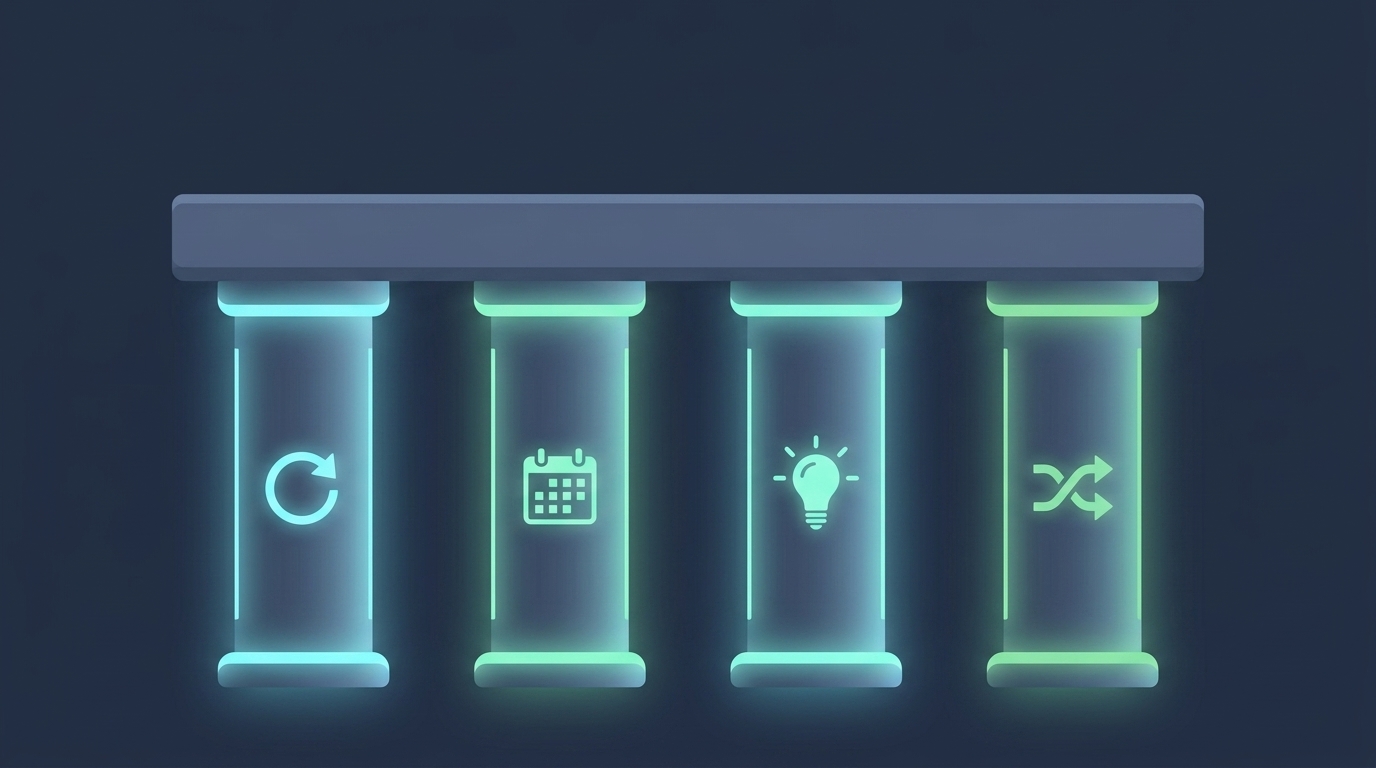
Your Weekly Retention System
Individually these are tips. Combined and scheduled, they're a system. Here's what it looks like across a week, at roughly ten minutes a day:
- Every day (10 minutes). Two minutes of blank-page recall on yesterday's material, five minutes on one new concept plus its two elaboration sentences, three minutes self-testing what you just covered. One concept. Not a chapter.
- Every third day (10 minutes). An interleaved review: questions pulled at random from everything you've covered so far, in no particular order.
- Once a week (20 minutes). A teach-back. Explain the week's material out loud, or in writing, as if to someone who has never seen it. Anything you stumble on goes to the front of tomorrow's queue.
- Once a month (20 minutes). One pass over the oldest material — the stuff you're confident you still know. That confidence is exactly what makes it the highest-risk material in your collection.
Nothing here is difficult. The part that breaks is the bookkeeping: knowing which of two hundred concepts is due today, which you got wrong last time, and which has earned a longer gap. That's a scheduling problem, and it's why ten-minute sessions only compound when something is tracking the intervals for you.
Three Ways This System Breaks
- Reviewing by rereading. The most common failure is doing the schedule right and the retrieval wrong. If your "review" consists of looking over your notes, you've rebuilt the familiarity trap on a fancier calendar. A review that doesn't make you produce something from memory isn't a review.
- Reviewing only what you got wrong. Tempting, and half right. Wrong answers do need to come back sooner, but the material you're most confident about is the material you stop testing, which is how it quietly disappears. Everything comes back eventually; the gap just gets longer.
- Front-loading the effort. A ninety-minute session building the perfect question set on Sunday, then nothing on Tuesday, is not this system. Spread across a month, the same five hours beats a single weekend, and it isn't close (Cepeda et al., 2006). Consistency is doing the work here, not intensity.
Frequently Asked Questions
How often should I review what I learn?
Start with a review the day after you first learn something, then roughly three days later, a week later, two weeks later, and a month later. The intervals widen each time you successfully recall the material and should shorten again whenever you can't. The precise numbers matter far less than the pattern: early, then progressively less often.
Does highlighting work?
Not for retention. Dunlosky and colleagues' 2013 review rated highlighting and underlining as low-utility techniques — they create a strong sense of familiarity without requiring you to retrieve anything. Highlighting is useful for one thing only: marking what you'll later turn into questions. The questions are what does the work.
What are the best apps for remembering what you learn?
Look for two features and ignore everything else: it must make you produce answers from memory rather than recognize them, and it must schedule your reviews at widening intervals automatically. Traditional flashcard tools with a spaced repetition algorithm do this well if you're willing to build your own decks; AI-based tools generate the questions for you from the material itself. We compare the options in our roundup of the best spaced repetition apps.
The System, Minus the Bookkeeping
You don't need to study more. You need what you already study to come back at the right moments, in a form that makes you retrieve it. That's four techniques and a calendar — and the calendar is the part humans reliably abandon.
Mind Tiles builds the whole loop for you. Give it a topic, or upload your own notes, PDFs, or slides, and it produces 10 to 15 minute modules with recall questions written in, mixed reviews, and spaced repetition scheduling that decides what's due before you open the app. Start your 7-day free trial — no credit card required — and find out what a month of learning looks like when far less of it leaks.