How to Turn Your Notes Into a Course That Sticks
Everyone with an exam coming up owns the same graveyard: a folder of lecture slides, a PDF of the official study guide, and a notebook of handwriting that made perfect sense in the moment. The plan is always to "go through them." Going through them means rereading, rereading builds familiarity, and familiarity is the great impostor of studying. It feels like knowing. The exam disagrees.
What your notes are missing isn't information. It's structure and interrogation: a sequence to learn in, questions that force you to retrieve, and a schedule that brings each idea back right before you'd forget it. That used to mean weeks of making flashcards by hand. Now you can hand your material to AI and get the whole system built for you. This guide covers how to do it with Mind Tiles' Custom Mind Tile feature, what it does with your material, and the fine print worth knowing before your exam gets any closer.
What is a Custom Mind Tile?
A Custom Mind Tile is a course built from your own material instead of a topic you type in. You paste your notes, upload a document, or photograph a page, and Mind Tiles turns it into the same thing it builds for any subject: bite-sized modules, exercises, games, and quizzes, wired into a spaced repetition schedule that manages your reviews automatically. The difference is the source. A regular Mind Tile teaches a topic; a Custom Mind Tile teaches your version of it, the one your course, your instructor, or your certification actually covers.
That distinction matters more than it sounds. Generic study material and your syllabus rarely agree on scope, emphasis, or terminology. When your quiz questions come from your own slides, you're practicing exactly what you'll be tested on, in the vocabulary your test will use.
What you can feed it
Three ways in, all from the same screen:
- Paste. Drop in notes, a syllabus section, or a study guide as text.
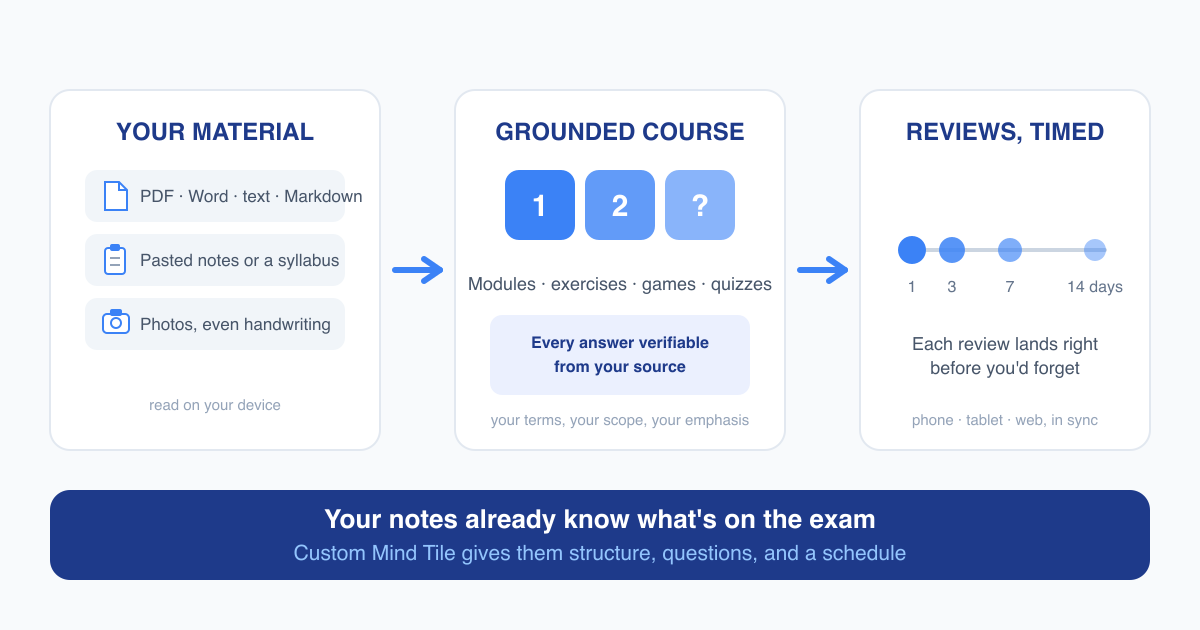
- Upload a file. PDF, Word document (.docx), plain text, or Markdown, up to 10MB and 60 PDF pages. Image files (JPG or PNG, up to 700KB each) work too, and you can select several at once, like a deck of slide screenshots.
- Snap a photo. On your phone, point the camera at a textbook page, a whiteboard, or your handwritten notes. Text recognition runs on your device first, and neat handwriting usually works. Trickier shots get escalated to AI vision for a second pass.
One batch of material becomes one course, and the practical ceiling is roughly six thousand words of source text, about the size of a chapter or a lecture's worth of slides. Bigger subjects work best as a series of Custom Mind Tiles, one per chapter, which conveniently is also how spaced repetition likes its material: in focused, reviewable chunks.
Two honest limitations: pasting a bare link doesn't work yet (importing from URLs is coming later), and scanned PDFs that are just photographs of pages are rejected, because they have no text layer to read. For those, photograph the pages directly instead.
What happens to your material
Before anything gets built, your content passes two checks. The first is instant and mechanical: is there enough text to work with, is it within the size limit. The second is an AI suitability assessment that reads the material and decides what it can honestly support: a full course with modules, exercises, and quizzes; a leaner modules-only path; or a flashcard-and-quiz set for material that's more list than lesson. If your notes are too thin in places, the course can add clearly-labeled supporting context rather than quietly padding your content with outside facts.
Then comes the part that makes this trustworthy for exam prep: generation is grounded. The builder is required to base all facts, terminology, examples, and structure on your source material, and to draw every quiz answer and exercise solution from it, labeling any added context as added; check anything that looks off against your notes. Your mnemonic devices, your professor's odd phrasing, the specific edge cases your certification loves: they stay yours. This is the difference between "AI wrote me a quiz about biology" and "AI wrote me a quiz about my biology notes."
Why does the quiz matter so much? Because retrieval is the part of studying that actually builds memory. In Roediger and Karpicke's 2006 experiment, students who tested themselves remembered up to about 50% more a week later than those who reread for the same time, and the effect, known as the testing effect, has replicated widely. We covered the evidence in depth in Active Recall vs Spaced Repetition, but the short version is: your notes become useful the moment they start asking you questions instead of being read.
Then the schedule takes over
Building the course is the visible half. The half that gets you through an exam is what happens next: every module and quiz enters a spaced repetition schedule based on the SM-2 algorithm. Recall something easily and its next review moves further out. Miss it and it returns tomorrow. Instead of deciding what to study each evening, you open the app and the queue is already the set of things closest to slipping away, synced across your phone, tablet, and the web.
This is the piece almost every self-made study system abandons by week two, because tracking expanding review intervals across dozens of subtopics is bookkeeping, and bookkeeping is where study plans go to die. The schedule is why material learned from a Custom Mind Tile keeps working weeks later, when the person who reread their notes five times is starting over. If you're curious about the timing itself, the forgetting curve explains why the intervals expand.
What about privacy?
Reasonable question, since this is your coursework, your job's training material, or your own handwriting. Text extraction and first-pass photo recognition run on your device. The extracted text (and, for hard-to-read photos, the image) is then sent to our AI provider to build the course. The extracted text is stored in your own account so your courses can stay grounded to it, you can see everything you've uploaded in one place, and you can delete any source permanently whenever you want.
How to get the most out of it
- One chapter, one tile. Focused sources produce sharper questions than a whole semester pasted at once.
- Feed it your worst subject first. The material you understand least is where grounded quizzing pays off most.
- Photograph as you go. A page snapped after each lecture beats a panicked scanning session before finals.
- Trust the misses. When the same question keeps returning, that's the system finding your actual weak spot. It comes back tomorrow for a reason.
Frequently asked questions
Can I turn a PDF into a course?
Yes. Upload a text-based PDF up to 10MB and 60 pages, and Mind Tiles builds modules, exercises, and quizzes grounded in its content. Scanned PDFs without a text layer are the exception; photograph those pages instead and the photo route handles them.
Does it work with handwritten notes?
Usually, yes. Photograph the page and on-device text recognition reads it; neat handwriting works best, and harder shots are escalated to AI vision for a second attempt. Very messy or heavily angled writing may still need a cleaner photo.
Will the quiz answers actually come from my material?
By design, yes, though no generator is perfect, so check anything that looks off. Generation follows grounding rules: facts, terminology, and structure come from your source, and to draw every quiz answer and exercise solution from it, labeling any added context as added; check anything that looks off against your notes. If your material is too thin for a full course, added context is clearly labeled rather than silently mixed in.
Is my uploaded content used to train AI?
No. Mind Tiles does not use your uploads to train models. Your text is sent to our AI providers (OpenAI and Anthropic) through their APIs to generate your course, and both providers' API terms exclude that data from model training. Your sources are stored in your own account for your own courses, and you can delete any of them permanently at any time.
Do I need a paid plan to use Custom Mind Tiles?
No. Creating a course from your own content is available to everyone; free accounts have monthly generation and topic allowances it counts toward, and there's a 7-day free trial of the full experience with no credit card required.
Your notes, finally working for you
The material you already have is the best study resource you own. It's scoped to your exact exam, written in your exact vocabulary, and it cost you weeks of classes to produce. It just can't quiz you by itself.
Now it can. Start a free 7-day trial of Mind Tiles, tap Custom Mind Tile, and hand it a chapter, a PDF, or a photo of last week's notes. It will build the course, write the questions from your material, and schedule every review so what you learned has a far better chance of staying learned.