Anki Alternatives for People Who Don't Want to Build Decks (2026)
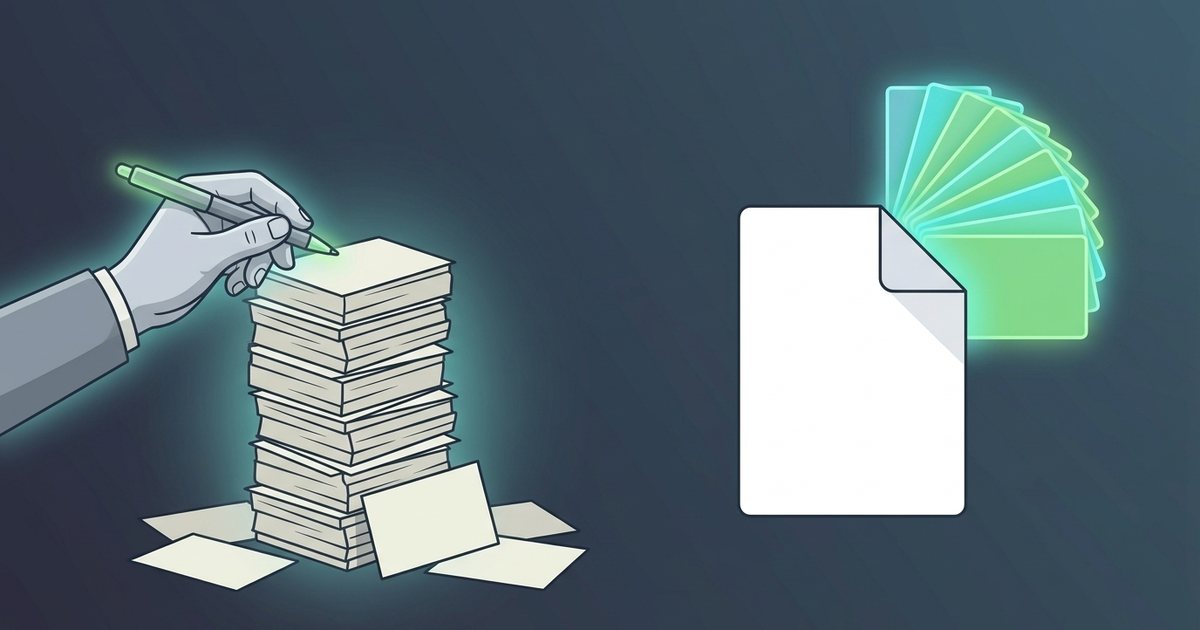
Anki is the best-known free flashcard app, and for good reason, and most people who go looking for an alternative are not leaving because of the reviews. They are leaving because of the deck. Every card in Anki is a card someone had to write, and for a lot of learners the writing takes longer than the learning. This guide sorts the alternatives by the reason you are actually looking: you want to keep Anki but stop typing cards, you want a friendlier flashcard app, or you want to stop thinking in cards altogether and just feed the app your notes.
Prices below are in USD, taken from each vendor's site in September 2026 except where noted; they change, so check before you buy. Anki, Quizlet, RemNote, and Brainscape are trademarks of their respective owners; Mind Tiles is not affiliated with or endorsed by any of them.
What Anki gets right, so you know what you would be giving up
Be honest about this part before switching. Anki is free and open source on desktop, free on Android (AnkiDroid) and on AnkiWeb, with a one-time $24.99 AnkiMobile purchase that funds core development. Its scheduler descends from SuperMemo's SM-2 and is the one most others are measured against, it has a large add-on ecosystem, and a decade of shared decks exists for medicine, languages, and law. If you already have ten thousand cards you trust and a review habit that works, nothing on this page will beat it. Keep Anki.
The people who should keep reading are the ones who have opened Anki, made forty cards in an evening, and never opened it again.
The real reason people leave: the deck has to be built
Anki gives you a scheduler and an empty box. Filling the box is your job. That is fine if you are a medical student inheriting a shared deck that maps to your curriculum. It is a wall for everyone else: a professional studying for a certification from a 300-page PDF, a language learner working from a textbook, a student with a semester of lecture slides. The cards do not exist yet, and writing good ones is slow, skilled work. Shared decks help only when someone else already learned exactly your material in exactly your order, which is rarer than it sounds.
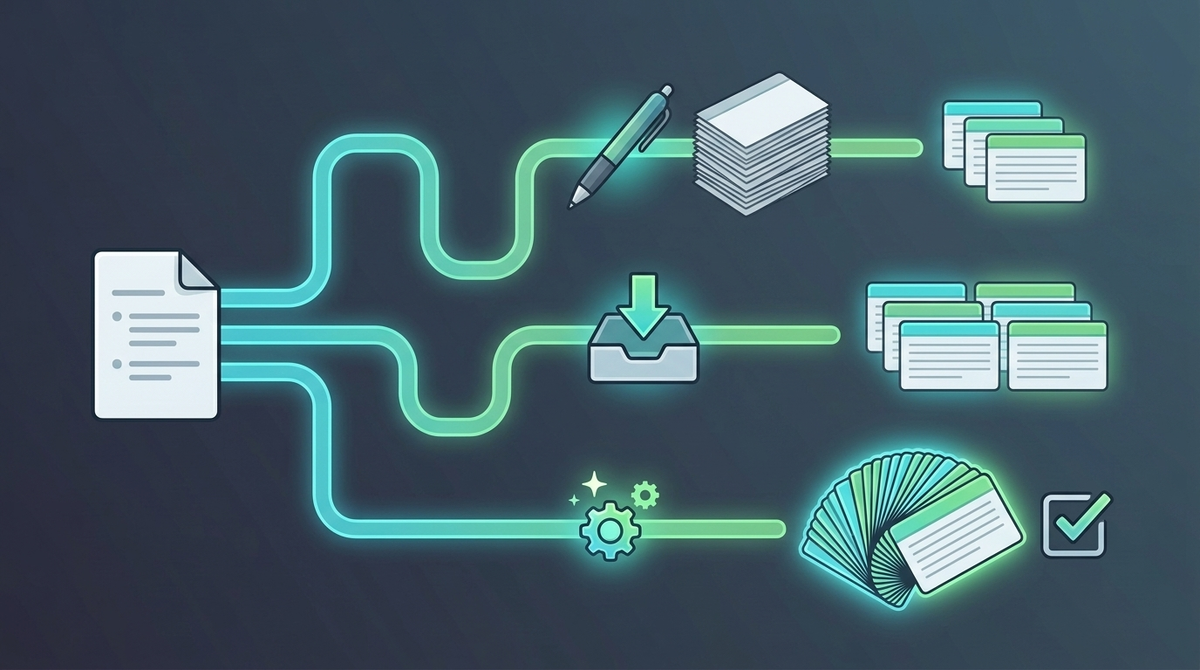
There are three ways out of that box, and they are the three sections that follow.
Option 1: Keep Anki, stop typing cards
If the scheduler and the ecosystem are why you chose Anki, the cheapest fix is to keep it and add a generator in front of it.
- RemNote is a notes app with flashcards built in, and its paid tiers generate cards from text, PDFs, and slides. The free plan includes a small monthly allowance of AI credits (250 at the time of writing, about two per generation); Pro is $8 a month (or $96 billed yearly) with 1,000 credits, and Pro with AI is $18 a month ($216 yearly) with 20,000, so heavy use is a paid feature. RemNote can be your whole system, or the place you draft cards before moving them.
- Brainscape is closer to Anki in spirit: a flashcard app with spaced repetition and a large library of pre-made decks. Its free tier lets you make cards by hand, import existing decks, and use AI to generate hundreds of cards; Pro, $19.99 month to month or $7.99 a month billed yearly, removes the cap.
- Anki's own add-ons. Community add-ons that call an AI model to draft cards from selected text exist and change often. They are the most Anki-native answer and the most fiddly, and you are responsible for the API key and the quality control.
The trade-off across all three: you still end up with a deck of cards, and cards written by a model from a chapter still need a human pass. Read the first ten before you trust the rest. The PDF-to-flashcards guide covers the four things to check.
Option 2: A friendlier flashcard app
Some people are not leaving Anki because of the deck. They are leaving because Anki's interface is utilitarian and has a learning curve, and they want something that works on a phone without reading a manual.
- Quizlet is the mainstream choice: study sets, games, and a large public library. Its Magic Notes feature generates cards from uploaded notes; full use is reported to require Quizlet Plus, with limited free access. Third-party pricing roundups put Plus at $7.99 a month or $35.99 a year at the time of writing (Quizlet's public site did not display prices when we checked, so these are third-party figures). Quizlet's scheduling is less configurable than Anki's, which suits casual study more than a multi-year deck.
- Brainscape, again, if you want Anki's approach with a modern interface and a marketplace of decks; the confidence-rating system is easy to explain to a beginner.
The trade-off: you give up Anki's scheduler depth and add-ons for a nicer surface. For most people studying for one exam that is the right trade. For someone maintaining a long-term language deck, it usually is not.
Option 3: Stop thinking in cards
The third group has a different complaint. Flashcards are one shape of practice, and for a lot of material it is the wrong shape: you do not remember a chapter on cellular respiration as forty facts, you remember it as a process you can explain. What these learners want is to hand over the material and get back something to study, not a box to fill.
This is the job Mind Tiles is built for, so read this section as the vendor's description and check it against a free trial. You upload a PDF, a Word file, plain text, or photos of slides and handwriting (documents up to 10MB and 60 pages; photos are read with on-device text recognition, with AI vision as the fallback for handwriting). It reads the material and builds a short course from it: bite-sized modules, exercises, and a quiz, written from your file, with any added context labeled as added. Then it does the part Anki does well, on its own: every item goes onto a spaced-repetition schedule, and the app tells you what to review each day in ten to fifteen minutes.
What it costs: a free tier with five topics and five generations a month, then $7.99 a month, $19.99 a quarter, or $59.99 a year, with a 7-day free trial for new accounts. What it is not: a card database. If your identity as a learner is a 10,000-card collection with a decade of review history, Mind Tiles will not import it and is not trying to replace it. It is for the person whose material is still in a PDF and who wants to start reviewing tonight.
The comparison, in one table
| App | How cards get made | Scheduler | Price (USD) | Best for |
|---|---|---|---|---|
| Anki | You write them, or import a shared deck | The reference; deep, configurable | Free on desktop, Android, web; $24.99 one-time on iPhone | Long-term collections, medicine, languages, anyone with a deck already |
| RemNote | Hand-written, or AI-generated from text, PDF, and slides (credit allowance per plan) | Built-in spaced repetition | Free (250 AI credits/mo); Pro $8/mo; Pro with AI $18/mo | Note-takers who want cards to fall out of their notes |
| Brainscape | Hand-written, imported, or AI-generated (hundreds free, unlimited on Pro) | Confidence-based repetition | Free; Pro $19.99/mo, or $7.99/mo billed yearly | Anki's approach with a friendlier interface and a deck marketplace |
| Quizlet | Hand-written, public sets, or Magic Notes on Plus | Simpler, session-based | Free; Plus about $7.99/mo or $35.99/yr (third-party figures, not verified on Quizlet's site) | Casual study, class-wide shared sets, games |
| Mind Tiles | Generated from your own files and photos: modules, exercises, and a quiz | Built-in spaced repetition, ten to fifteen minutes a day | Free (5 topics, 5 generations/mo); $7.99/mo, $19.99/qtr, $59.99/yr; 7-day trial | Learning from a PDF, slides, or notes without building a deck |
How to choose in three questions
- Do you already have a deck you trust? If yes, stay on Anki and spend your energy on the review habit, not the app.
- Is your material a file, or is it in your head? If it is a file, the generators in options 1 and 3 save you the evening of typing. If it is vocabulary you are collecting day by day, hand-written cards in Anki or Quizlet are still the fastest.
- Do you want to end up with cards, or with something to study? Cards are right for facts, dates, and vocabulary. A generated course with exercises and a quiz is right for processes, chapters, and anything you will have to explain rather than recall. Most exam prep is a mix, which is why the free tiers exist: try one chapter each way and see which one you actually open on day three.
Whichever you choose, the app is the smaller decision. The review schedule is what produces the retention, and every tool on this page can run one (if the term is new, what a spaced repetition app does is the two-minute version). The spaced repetition apps roundup compares the schedulers in more depth, and active recall versus spaced repetition explains why a card you generated still has to be retrieved, not reread.
Frequently Asked Questions
Is there a free Anki alternative that makes the cards for me?
Partly. Brainscape's free tier generates hundreds of AI cards, RemNote's free plan includes a monthly allowance of AI credits, and Mind Tiles' free tier includes five generations a month. The vendors here all put unlimited generation on a paid plan, since each generation has a cost. Anki is free on every platform except iPhone, and out of the box it does not make cards for you.
Can I move my Anki decks to these apps?
Brainscape advertises importing existing flashcards, and RemNote is built to hold flashcards alongside notes; check each app's current import options for Anki's file format before you commit. Mind Tiles works from source material rather than decks, so it does not import an Anki collection. If your deck is the asset, keep it in Anki.
Is Anki really free?
Yes on desktop, Android, and AnkiWeb. The iPhone app, AnkiMobile, is a one-time $24.99 purchase with no subscription, and the project describes it as priced like a computer application to fund development of everything else.
Are AI-generated flashcards as good as ones I write myself?
Writing a card is itself a form of studying, so a hand-written deck has done some of the learning before the first review. Generated cards skip that step, which is exactly why they save time, and it means the first pass through them is where the understanding happens. Check the first ten for errors, delete the trivial ones, and treat the first review session as the study session it is.
Which is best for medical school or language learning?
Anki, in most cases. Both fields have mature shared decks and learners who review for years, which is where Anki's scheduler and community are strongest. The alternatives above are for material that does not come with a ready-made deck.
Start from the file you already have
If your notes are sitting in a PDF and you have not made a single card yet, that is the situation Mind Tiles was built for. Upload one chapter, let it build the modules and quiz, and see whether you open it on day three. The free tier covers five generations a month, and the 7-day trial opens the full app at $7.99 a month after that, with no card required to start.