What Is a Spaced Repetition App? How It Works and Why It Beats Studying Harder
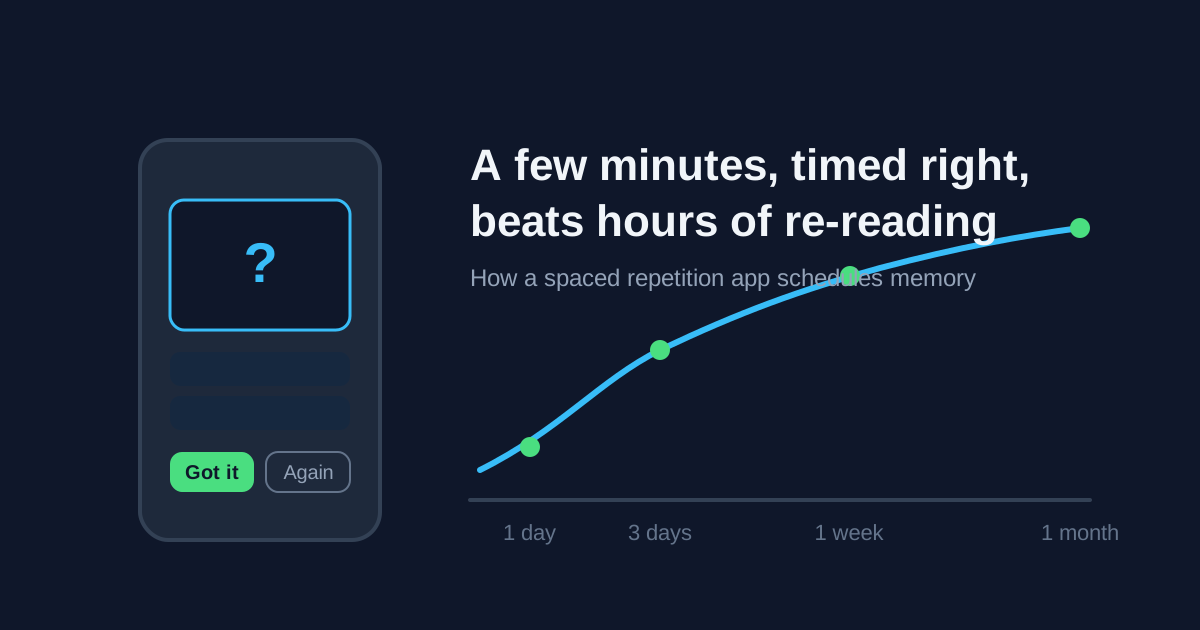
In Hermann Ebbinghaus's 1885 self-experiments with nonsense syllables, roughly two-thirds of what he learned was gone within a day, a pattern he mapped as the forgetting curve. A spaced repetition app fights that curve directly: it schedules quick reviews right before you would forget, so a single short session of practice can stick for weeks, then months, then years.
If you've ever crammed for an exam and watched the material evaporate a week later, you've felt the gap that spaced repetition is built to close. This guide explains exactly how a spaced repetition app works, why it consistently beats traditional studying, and how Mind Tiles turns the technique into an effortless daily habit on web, iOS, and Android.
What Is a Spaced Repetition App?
A spaced repetition app is a learning tool that uses an algorithm to decide the best moment to review each piece of information you're trying to remember. Instead of reviewing everything every day, it spaces out reviews at increasing intervals: one day, then three days, then a week, then a month, adapting to how well you recall each item.
Spaced review reaches comparable or better long-term retention than repeated re-reading in far less time (Cepeda et al., 2006). Modern spaced repetition apps like Mind Tiles do the scheduling math automatically, so all you have to do is open the app and answer a short queue of questions when prompted.
The Science: Why Spaced Repetition Beats Cramming
Spaced repetition is one of the most replicated findings in cognitive psychology. Three principles drive the gains:
- The forgetting curve. Without review, retention drops sharply within hours. Each successful review flattens the curve a little more.
- The spacing effect. Information reviewed over multiple sessions sticks far longer than the same total study time crammed into one session.
- Active recall. Pulling an answer from memory, instead of re-reading the textbook, strengthens the memory trace each time you do it. (We compared the two techniques in depth in Active Recall vs Spaced Repetition.)
A spaced repetition app combines all three. It prompts you with questions (active recall), at intervals tuned to your forgetting curve (spacing effect), so each review costs the smallest amount of time for the biggest memory gain.
How a Spaced Repetition App Schedules Your Reviews
Under the hood, a spaced repetition app tracks how each concept is doing: an ease rating that rises when you recall it and falls when you miss it, and the interval until its next review (how hard you personally find it). Each time you review a card and rate how well you recalled it, the algorithm updates both values and picks a new interval:
- You answered easily: the next review is pushed further out.
- You struggled: the next review comes sooner.
- You got it wrong: it resets to a short interval and rebuilds from there.
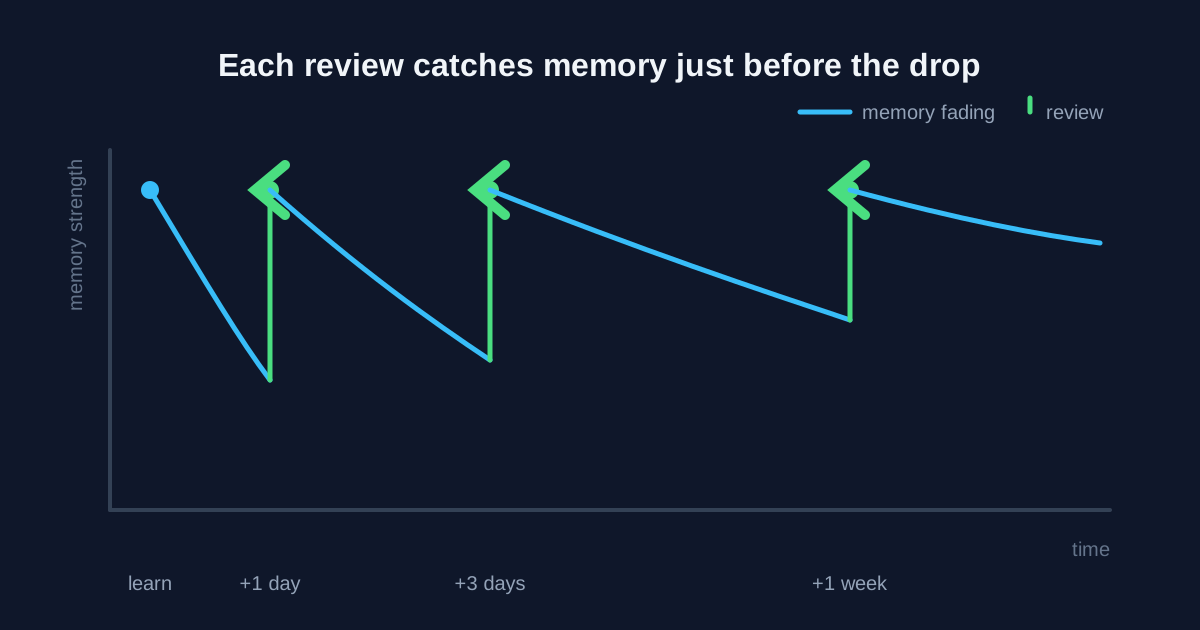
That feedback loop means a spaced repetition app gets sharper the more you use it: your review queue becomes a precise map of what you're about to forget, rather than a generic study list. If you're curious what the classic intervals look like in practice, our guide to the spaced repetition schedule walks through the exact timing.
5 Signs You Need a Spaced Repetition App
- You forget what you learn within days. If lessons evaporate before you can apply them, spaced reviews are the missing layer.
- You're studying for a long-horizon goal. Languages, medical exams, certifications, and professional skills all reward retention measured in months, not days.
- You read constantly but don't retain much. Reading without recall is a memory leak, and spaced repetition plugs it.
- You don't have time to re-read. A spaced repetition app compresses review into a few focused minutes a day.
- You want a single system across topics. One queue for languages, work concepts, and personal interests beats juggling notebooks and flashcard decks.
How Mind Tiles Uses Spaced Repetition
Mind Tiles is a personalized learning app built around spaced repetition, but designed for curious adults rather than test-prep grinders. A few things make the experience different:
- AI-generated review questions. Drop in a topic you care about, whether that's career skills, a book you're reading, or a language you're learning, and Mind Tiles produces the recall questions for you. No deck-building required.
- Adaptive scheduling. The SM-2 style scheduler lengthens the gap for concepts you recall and shortens it for ones you miss, so easy concepts get out of your way and tricky ones surface more often.
- Daily-tile interface. Instead of a giant study queue, Mind Tiles shows you a small set of bite-sized tiles each day. A session is designed to take about ten minutes.
- Sync across web, iOS, and Android. Start a review on your phone, finish it on the web app; your progress and queue follow you.
Spaced Repetition vs. Other Learning Methods
Spaced repetition isn't the only learning technique that works, but for long-term retention it consistently outperforms the most common alternatives:
| Method | Time required | Long-term retention |
|---|---|---|
| Cramming (re-reading the night before) | High, in one burst | Low: most of it fades within days |
| Highlighting / note-taking | Medium, ongoing | Low without review: recognition, not recall |
| Self-quizzing without spacing | Medium | Better: recall practice helps, but timing is unmanaged |
| Spaced repetition app | Low (minutes/day) | Highest: recall practice at managed intervals |
The math is simple: a spaced repetition app trades raw study hours for review timing. You spend less time, but every minute lands at the moment it has the largest memory payoff. Wondering how the big apps compare? We describe the main options in Best Spaced Repetition Apps in 2026.
Frequently Asked Questions
How long does it take to see results with a spaced repetition app?
Give it two weeks of consistent use: that's long enough for the first few review cycles to complete, which is when re-encountered items start feeling noticeably easier to recall. The compounding effect shows up around the one-month mark, when items you reviewed early start surfacing at longer intervals, already remembered.
Do I need to build my own flashcards?
Not with Mind Tiles. The app generates review questions from the topics you tell it you want to learn, so you can skip the deck-building work that puts many people off flashcard apps.
How many minutes a day should I spend?
Five to ten minutes is enough for most learners. The algorithm only surfaces the items at risk of being forgotten, so long sessions don't help more than short consistent ones.
Is spaced repetition only useful for memorization?
No. Spaced repetition strengthens any kind of knowledge you need to recall later, including concepts, frameworks, vocabulary, names, dates, and procedural steps. It's the retention layer underneath almost any deeper skill.
What makes Mind Tiles different from other spaced repetition apps?
Mind Tiles combines spaced repetition with AI-generated content, a clean daily-tiles interface, and cross-device sync. You get the science-backed retention engine without the chore of building flashcard decks.
Start Learning Smarter Today
If you're tired of forgetting what you learn, a spaced repetition app is one of the highest-leverage changes you can make to your learning routine. Mind Tiles gives you the full system: adaptive scheduling, AI-generated review questions, and a 10-minute-a-day rhythm, wrapped in an interface designed to feel like a habit, not homework.
Start your 7-day free trial of Mind Tiles, cancel anytime. Available on web, iOS, and Android.